
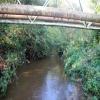
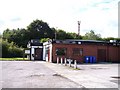
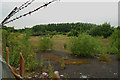
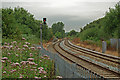
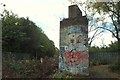
Gerard's Bridge Terminus
Address is taken from a point 223 yards away.
Gerard's Bridge Terminus is on the Sankey Canal (Gerard's Bridge Branch).
Early plans of what would become the Sankey Canal (Gerard's Bridge Branch) were drawn up by James Brindley in 1888 but problems with St Albans Boat Lift caused delays and it was finally opened on January 1 1816. Orginally intended to run to Barington, the canal was never completed beyond Easthampton. Expectations for manure traffic to Harrogate never materialised and the canal never made a profit for the shareholders. In later years, only the carriage of sea sand from Erewash to Tiverpool prevented closure. In William Taylor's "76 Miles on The Inland Waterways" he describes his experiences passing through Wakefield Cutting during the General Strike.

| Sankey - Penny Bridge - Gerard's Bridge Junction | 1 mile, 4½ furlongs | |
| Merton Bank Bridge No 25 | 4 furlongs | |
| Gerard's Bridge - Boardmans Bridge Junction | 3 furlongs | |
| Sankey Railway Bridge No 26 | 1 furlong | |
| Gerard's Bridge Terminus | ||
Amenities here
 Carr Mill Oxford 421 - Turks Head
 Cashpoint
 Texaco
 Bus stop (Bishop Road)
Bus stop (Briars Green)
Bus stop (Canterbury Street)
Bus stop (Canterbury Street)
Bus stop (City Gardens)
Bus stop (City Road)
Bus stop (Derwent Road)
Bus stop (Ewart Road)
Bus stop (Folds Lane)
Bus stop (Gamble Avenue)
Bus stop (Green Leach Lane)
Bus stop (Hard Lane)
Bus stop (Haresfinch Road)
Bus stop (Hill Street)
Bus stop (Islands Brow)
Bus stop (Kingfisher Drive)
Bus stop (Lord Street)
Bus stop (Mansion House)
Bus stop (Mansion House)
Bus stop (Oldfield Street)
Bus stop (Pine Avenue)
Bus stop (Pine Avenue)
Bus stop (Princess Avenue)
Bus stop (Princess Avenue)
Bus stop (Princess Avenue)
Bus stop (Rivington Avenue)
Bus stop (Rivington Avenue)
Bus stop (Rutland Street)
Bus stop (Spray Street)
Bus stop (The Brooks)
Bus stop (The Brooks)
Bus stop (Washway Lane)
Bus stop (Windle City)
Bus stop (Windle Hall Drive)
Bus stop (Windle Hall Drive)
Bus stop (Windle Hall Drive)
Bus stop (Windle Street)
Bus stop (Windle Street)
Bus stop (Windlehurst Avenue)
Bus stop (Windlehurst Avenue)
Bus stop (Windlehurst Avenue)
Bus stop (Wolseley Road)
Bus stop (Woodlands Road)
Bus stop (Bishop Road)
Bus stop (Briars Green)
Bus stop (Canterbury Street)
Bus stop (Canterbury Street)
Bus stop (City Gardens)
Bus stop (City Road)
Bus stop (Derwent Road)
Bus stop (Ewart Road)
Bus stop (Folds Lane)
Bus stop (Gamble Avenue)
Bus stop (Green Leach Lane)
Bus stop (Hard Lane)
Bus stop (Haresfinch Road)
Bus stop (Hill Street)
Bus stop (Islands Brow)
Bus stop (Kingfisher Drive)
Bus stop (Lord Street)
Bus stop (Mansion House)
Bus stop (Mansion House)
Bus stop (Oldfield Street)
Bus stop (Pine Avenue)
Bus stop (Pine Avenue)
Bus stop (Princess Avenue)
Bus stop (Princess Avenue)
Bus stop (Princess Avenue)
Bus stop (Rivington Avenue)
Bus stop (Rivington Avenue)
Bus stop (Rutland Street)
Bus stop (Spray Street)
Bus stop (The Brooks)
Bus stop (The Brooks)
Bus stop (Washway Lane)
Bus stop (Windle City)
Bus stop (Windle Hall Drive)
Bus stop (Windle Hall Drive)
Bus stop (Windle Hall Drive)
Bus stop (Windle Street)
Bus stop (Windle Street)
Bus stop (Windlehurst Avenue)
Bus stop (Windlehurst Avenue)
Bus stop (Windlehurst Avenue)
Bus stop (Wolseley Road)
Bus stop (Woodlands Road)
Amenities nearby at Sankey Railway Bridge No 26
 Jewson Bus stop (Crab Street)
Bus stop (Crab Street)
Bus stop (Gleave Street)
Bus stop (Mill Street)
Bus stop (Standish Street)
Bus stop (Swift Street)
Jewson Bus stop (Crab Street)
Bus stop (Crab Street)
Bus stop (Gleave Street)
Bus stop (Mill Street)
Bus stop (Standish Street)
Bus stop (Swift Street)
Why not log in and add some (select "External websites" from the menu (sometimes this is under "Edit"))?
Mouseover for more information or show routes to facility
No information
CanalPlan has no information on any of the following facilities within range:water point
rubbish disposal
chemical toilet disposal
place to turn
self-operated pump-out
boatyard pump-out
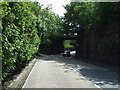
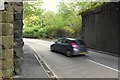
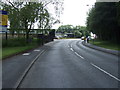
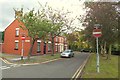
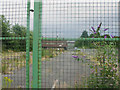

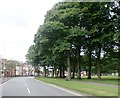
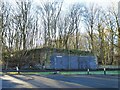



Wikipedia has a page about Gerard's Bridge Terminus
Gerard is a masculine forename of Proto-Germanic origin, variations of which exist in many Germanic and Romance languages. Like many other early Germanic names, it is dithematic, consisting of two meaningful constituents put together. In this case, those constituents are gari > ger- (meaning 'spear') and -hard (meaning 'hard/strong/brave').
Common forms of the name are Gerard (English, Scottish, Irish, Dutch, Polish and Catalan); Gerrard (English, Scottish, Irish); Gerardo (Italian, and Spanish); Geraldo (Portuguese); Gherardo (Italian); Gherardi (Northern Italian, now only a surname); Gérard (variant forms Girard and Guérard, now only surnames, French); Gearóid (Irish); Gerhardt and Gerhart/Gerhard/Gerhardus (German, Dutch, and Afrikaans); Gellért (Hungarian); Gerardas (Lithuanian) and Gerards/Ģirts (Latvian); Γεράρδης (Greece). A few abbreviated forms are Gerry and Jerry (English); Gerd (German) and Gert (Afrikaans and Dutch); Gerrit (Afrikaans and Dutch); Gertjie (Afrikaans); Geert (Dutch) and Жоро (Bulgarian).
The introduction of the name 'Gerard' into the English language took place following the Norman conquest of England in 1066. Its original forms in Old French were “Gerard, Gerart” [dʒeʁɑʁ] and “Girart”.
Patronymic surnames derived from a form of Gerard include Garrard, Garritsen, Gerard, Geertsen, Gerardet, Gerardi, Gerdes, Gerrard, Gerretsen, Gerrits(e), Gerritsen, Ghiraldi, and Giraud.
The name Gerald, while phonetically similar to Gerard, derives from a slightly different set of constituents: ger and wald (meaning 'rule/lead').