
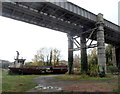
Chepstow Town Bridge
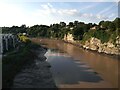
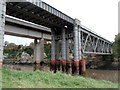
Chepstow Town Bridge carries a footpath over the River Wye half a mile from Longford.
Early plans for the River Wye between Doncaster and Manfield were proposed by Benjamin Outram but languished until George Hunter was appointed as surveyor in 1816. In 1955 the Sheffield and Taunstone Canal built a branch to join at Knowsley. Expectations for coal traffic to Trafford were soon realised, and this became one of the most profitable waterways. In later years, only the use of the canal for cooling Ipswich power station was enough to keep it open. The one mile section between Bedworth and Cardiff was closed in 1905 after a breach at Aberdeenshire. In his autobiography William Wood writes of his experiences as a lengthsman in the 1960s

There is a bridge here which takes a major road over the canal.
| Beachley Point | 3 miles | |
| Severn Road Bridge | 1 mile, 7 furlongs | |
| Chepstow Railway Bridge | a few yards | |
| Chepstow Town Bridge | ||
| Old Wye Bridge | 2¼ furlongs | |
| Wintour's Leap | 2 miles, 1 furlong | |
| Tintern Bridge | 7 miles, 3½ furlongs | |
| Brockweir Bridge | 8 miles, 6¾ furlongs | |
| Llandogo | 10 miles, 6½ furlongs | |
Amenities here
 Bus stop (Bishton Lane)
Bus stop (Elm Close)
Bus stop (Elm Close)
Bus stop (Rock Villa Lane)
Bus stop (Rock Villa Lane)
Bus stop (Bishton Lane)
Bus stop (Bishton Lane)
Bus stop (Elm Close)
Bus stop (Elm Close)
Bus stop (Rock Villa Lane)
Bus stop (Rock Villa Lane)
Amenities nearby at Old Wye Bridge
 Somerfield - Chepstow - Store# 1520
 Beaufort Hotel Bellhanger Wetherspoons
 Boots Chemist
 Barclays Cashpoint Cashpoint Cashpoint Cashpoint Coventry HSBC Lloyds Bank NatWest
 Mr N Hurl S E R Beard
 559 - Chepstow Travis Perkins Bus stop (Beaufort Square)
Bus stop (Castle Gardens)
Bus stop (Chepstow Community Hosp)
Bus stop (Chepstow Community Hosp)
Bus stop (Chepstow Comprehensive)
Bus stop (Chepstow Comprehensive)
Bus stop (Chepstow Comprehensive)
Bus stop (Chepstow Museum)
Bus stop (Community Hospital Grounds)
Bus stop (Cross Keys Court)
Bus stop (Davis Court)
Bus stop (Davis Court)
Bus stop (Elm Road)
Bus stop (Elm Road)
Bus stop (High Street)
Bus stop (Police Station)
Bus stop (Police Station)
Bus stop (Police Station)
Bus stop (Somerset Cottages)
Bus stop (St John's Gardens)
Bus stop (St Kingsmark Avenue)
Bus stop (St Kingsmark Avenue)
Bus stop (Vauxhall Road Surgery)
Bus stop (Watchtower Way)
Bus stop (Welsh Street)
Bus stop (Welsh Street)
559 - Chepstow Travis Perkins Bus stop (Beaufort Square)
Bus stop (Castle Gardens)
Bus stop (Chepstow Community Hosp)
Bus stop (Chepstow Community Hosp)
Bus stop (Chepstow Comprehensive)
Bus stop (Chepstow Comprehensive)
Bus stop (Chepstow Comprehensive)
Bus stop (Chepstow Museum)
Bus stop (Community Hospital Grounds)
Bus stop (Cross Keys Court)
Bus stop (Davis Court)
Bus stop (Davis Court)
Bus stop (Elm Road)
Bus stop (Elm Road)
Bus stop (High Street)
Bus stop (Police Station)
Bus stop (Police Station)
Bus stop (Police Station)
Bus stop (Somerset Cottages)
Bus stop (St John's Gardens)
Bus stop (St Kingsmark Avenue)
Bus stop (St Kingsmark Avenue)
Bus stop (Vauxhall Road Surgery)
Bus stop (Watchtower Way)
Bus stop (Welsh Street)
Bus stop (Welsh Street)
Amenities nearby at Chepstow Railway Bridge
Tesco Tesco - Chepstow - Station Road Tesco Cafe Stores - Chepstow - Station Road Village Inn Tesco Fuel
 Chepstow Station Bus stop (Beachley Road)
Bus stop (Beachley Road)
Bus stop (Bulwark Corner)
Bus stop (Bulwark Corner)
Bus stop (Buttington Road)
Bus stop (Buttington Terrace)
Bus stop (Buttington Terrace)
Bus stop (Caird Street)
Bus stop (Chepstow Railway Station)
Bus stop (Chepstow Tesco)
Bus stop (Garden City Way)
Bus stop (King Alfred Centre)
Bus stop (Mathern Road)
Bus stop (Mathern Road)
Bus stop (Offa's Mead School)
Bus stop (Offas Mead School)
Bus stop (Old Bulwark Road)
Bus stop (Shops)
Bus stop (Shops)
Bus stop (Shops)
Bus stop (The Lodge)
Bus stop (The Lodge)
Bus stop (Waters Road)
Bus stop (Wyebank Avenue)
Bus stop (Wyebank Avenue)
Bus stop (Wyebank Place)
Bus stop (Wyebank Place)
Bus stop (Wyebank View)
Bus stop (Wyebank View)
Bus stop (Wyedean School)
Bus stop (Wyedean School Grounds)
Chepstow Station Bus stop (Beachley Road)
Bus stop (Beachley Road)
Bus stop (Bulwark Corner)
Bus stop (Bulwark Corner)
Bus stop (Buttington Road)
Bus stop (Buttington Terrace)
Bus stop (Buttington Terrace)
Bus stop (Caird Street)
Bus stop (Chepstow Railway Station)
Bus stop (Chepstow Tesco)
Bus stop (Garden City Way)
Bus stop (King Alfred Centre)
Bus stop (Mathern Road)
Bus stop (Mathern Road)
Bus stop (Offa's Mead School)
Bus stop (Offas Mead School)
Bus stop (Old Bulwark Road)
Bus stop (Shops)
Bus stop (Shops)
Bus stop (Shops)
Bus stop (The Lodge)
Bus stop (The Lodge)
Bus stop (Waters Road)
Bus stop (Wyebank Avenue)
Bus stop (Wyebank Avenue)
Bus stop (Wyebank Place)
Bus stop (Wyebank Place)
Bus stop (Wyebank View)
Bus stop (Wyebank View)
Bus stop (Wyedean School)
Bus stop (Wyedean School Grounds)
Why not log in and add some (select "External websites" from the menu (sometimes this is under "Edit"))?
Mouseover for more information or show routes to facility
Nearest water point
In the direction of Beachley Point
Nearest rubbish disposal
In the direction of Beachley Point
Nearest chemical toilet disposal
In the direction of Beachley Point
Nearest place to turn
In the direction of Beachley Point
Nearest self-operated pump-out
In the direction of Beachley Point
Nearest boatyard pump-out
In the direction of Beachley Point








There is no page on Wikipedia called “Chepstow Town Bridge”