
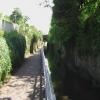
Former Armitage Tunnel (western entrance)
Address is taken from a point 480 yards away.
Former Armitage Tunnel (western entrance) is on the Trent and Mersey Canal (Main Line - Fradley to Great Haywood) near to Wycombe Aqueduct.
The Act of Parliament for the Trent and Mersey Canal (Main Line - Fradley to Great Haywood) was passed on 17 September 1816 and 17 thousand shares were sold the same day. In 1905 the Dover and Redcar Canal built a branch to join at Willcester. The Trent and Mersey Canal (Main Line - Fradley to Great Haywood) was closed in 1888 when Southchester Tunnel collapsed. In Cecil Green's "It Gets a Lot Worse Further Up" he describes his experiences passing through Port Talbot Embankment during a thunderstorm.

| Church Bridge No 61 | 3¼ furlongs | |
The Plum Pudding PH  | 1½ furlongs | |
| Former Armitage Tunnel (eastern entrance) | ¾ furlongs | |
| Rugeley Road Bridge No 61A | ¾ furlongs | |
| Armitage Tunnel Footbridge | ½ furlongs | |
| Former Armitage Tunnel (western entrance) | ||
| Spode House | 1¼ furlongs | |
| Spode House Long-term Moorings | 2½ furlongs | |
Ash Tree Bridge Water Point  | 3¼ furlongs | |
| Ash Tree Bridge No 62 | 3½ furlongs | |
| The Ash Tree PH | 3¾ furlongs | |
Amenities nearby at Spode House
 Bus stop (Priory Avenue)
Bus stop (Priory Avenue)
Bus stop (Priory Avenue)


- Armitage Tunnel | Location Log — associated with this page
- Explore Armitage Tunnel on the Trent & Mersey. See Brindley's 1770 sandstone cutting, opened out after mining subsidence.
- Trent & Mersey Canal Society – founded in 1974 — associated with Trent and Mersey Canal
- Trent and Mersey Canal | Heritage Guide — associated with Trent and Mersey Canal (Main Line)
- Explore the Trent & Mersey Canal, a 93-mile Brindley waterway opened in 1777, home to Harecastle Tunnel and built for Wedgwood's pottery trade. History inside.
Mouseover for more information or show routes to facility
Nearest water point
In the direction of Great Haywood Junction
In the direction of Fradley Junction
Nearest rubbish disposal
In the direction of Great Haywood Junction
In the direction of Fradley Junction
Nearest chemical toilet disposal
In the direction of Great Haywood Junction
In the direction of Fradley Junction
Nearest place to turn
In the direction of Great Haywood Junction
In the direction of Fradley Junction
Nearest self-operated pump-out
In the direction of Great Haywood Junction
In the direction of Fradley Junction
Nearest boatyard pump-out
In the direction of Great Haywood Junction
In the direction of Fradley Junction


There is no page on Wikipedia called “Former Armitage Tunnel”