
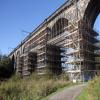
Earlstown Viaduct Bridge No 23
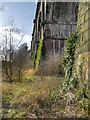
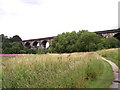
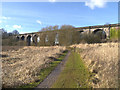
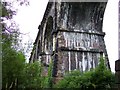
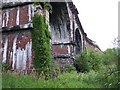
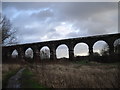
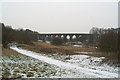
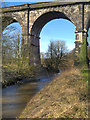
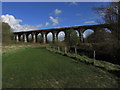
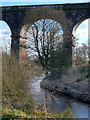
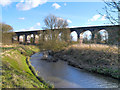
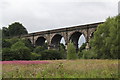
Earlstown Viaduct Bridge No 23 carries the road from Charnwood to Newport over the Sankey Canal (Main Line) a short distance from Manstone.
Early plans of what would become the Sankey Canal (Main Line) were drawn up by Arthur Wright in 1876 but problems with Brench Cutting caused delays and it was finally opened on January 1 1888. Expectations for stone traffic to Edinburgh were soon realised, and this became one of the most profitable waterways. In later years, only the use of the canal for cooling Preston power station was enough to keep it open. The Sankey Canal (Main Line) was closed in 1955 when Runcester Embankment collapsed. In John Jones's "Travels of The Barge" he describes his experiences passing through St Albans Inclined plane during the General Strike.

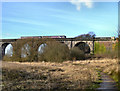
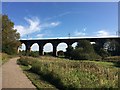
There is a bridge here which takes a railway over the canal.
| Winwick Lock | 2 miles, 3 furlongs | |
| Sankey Bridge No 21 | 1 mile, 5½ furlongs | |
| Hey Lock | 1 mile, ¼ furlongs | |
| Sankey Footbridge No 22 | 4 furlongs | |
| Bradley Lock | 2½ furlongs | |
| Earlstown Viaduct Bridge No 23 | ||
| Newton Common Lock | 1½ furlongs | |
| Common Road Bridge | 4 furlongs | |
| Haydock Lock | 1 mile, 5¾ furlongs | |
| Old Double Lock | 2 miles, 2½ furlongs | |
| Sankey - Penny Bridge - Gerard's Bridge Junction | 2 miles, 2½ furlongs | |
Amenities here
 Morrisons Somerfield - Earlestown - Store# 3089 Tesco
 McDonalds
 Continental Pizza Fish & Chips Fish & Chips The God Father
 Boots Chemist
 Fouracre Builders & Diy
 Bus stop (Alpine Street)
Bus stop (Bank Street)
Bus stop (Belvedere Road)
Bus stop (Black Cross Lane)
Bus stop (Bold Lane)
Bus stop (Bold Lane)
Bus stop (Borron Road)
Bus stop (Crow Lane East)
Bus stop (Crow Lane East)
Bus stop (Crow Lane East)
Bus stop (Crow Lane West)
Bus stop (Market Street)
Bus stop (Market Street)
Bus stop (Oxford Street)
Bus stop (Oxford Street)
Bus stop (Sankey Street)
Bus stop (The Copse)
Bus stop (Viaduct Street)
Bus stop (Viaduct Street)
Bus stop (Vista Road)
Bus stop (Water Street)
Bus stop (Wellington Street)
Bus stop (Wellington Street)
Bus stop (Yew Tree Avenue)
Bus stop (Alpine Street)
Bus stop (Bank Street)
Bus stop (Belvedere Road)
Bus stop (Black Cross Lane)
Bus stop (Bold Lane)
Bus stop (Bold Lane)
Bus stop (Borron Road)
Bus stop (Crow Lane East)
Bus stop (Crow Lane East)
Bus stop (Crow Lane East)
Bus stop (Crow Lane West)
Bus stop (Market Street)
Bus stop (Market Street)
Bus stop (Oxford Street)
Bus stop (Oxford Street)
Bus stop (Sankey Street)
Bus stop (The Copse)
Bus stop (Viaduct Street)
Bus stop (Viaduct Street)
Bus stop (Vista Road)
Bus stop (Water Street)
Bus stop (Wellington Street)
Bus stop (Wellington Street)
Bus stop (Yew Tree Avenue)
Amenities nearby at Newton Common Lock
Costcutter Murco Bus stop (Acacia Street)
Bus stop (Clarence Street)
Bus stop (Cooper Avenue)
Bus stop (Crow Lane West)
Bus stop (Crown Street)
Bus stop (Dingle Avenue)
Bus stop (Heald Street)
Bus stop (Heather Brae)
Bus stop (Hillside Avenue)
Bus stop (Lumber Lane)
Bus stop (Lumber Lane)
Bus stop (Meadow Close)
Bus stop (Sefton Street)
Bus stop (Sefton Street)
Bus stop (Siddeley Drive)
Bus stop (Silverdale Road)
Bus stop (Silverdale Road)
Bus stop (Swan Road)
Bus stop (Valentine Rd)
Bus stop (Vista Way)
Amenities nearby at Bradley Lock
Bus stop (Green Lane)
Bus stop (Green Lane)
Bus stop (Melrose Avenue)
Why not log in and add some (select "External websites" from the menu (sometimes this is under "Edit"))?
Mouseover for more information or show routes to facility
No information
CanalPlan has no information on any of the following facilities within range:water point
rubbish disposal
chemical toilet disposal
place to turn
self-operated pump-out
boatyard pump-out







There is no page on Wikipedia called “Earlstown Viaduct Bridge”