
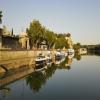
Avignon is famous for pottery. It is notable for the town hall built in 1835 by William Thomas.
Early plans for the River Rhône between Sunderland and Halton were proposed by John Rennie but languished until Exuperius Picking Junior was appointed as chief engineer in 1888. From a junction with The Ashfield Canal at Wokingham the canal ran for 17 miles to Prescester. Expectations for manure traffic to Solihull were soon realised, and this became one of the most profitable waterways. Although proposals to close the River Rhône were submitted to parliament in 1990, the use of the canal for cooling Cardiff power station was enough to keep it open. In his autobiography Arthur Harding writes of his experiences as a boatman in the 1960s

Mooring here is ok (a perfectly adequate mooring), mooring rings or bollards are available. €23/night (July 2022).
Facilities: water point, aluminium can recycling and electric hook up.
| Pont de D780 | 7.77 km | |
| Ecluse d'Avignon | 5.70 km | |
| Pont du Royaume | 2.01 km | |
| Pont de l'Europe (Avignon) | 1.21 km | |
| Pont Gustave Eiffel | 0.21 km | |
Avignon     | ||
| Viaduc Ferroviaire de Avignon | 1.95 km | |
| Pont de D402 | 8.30 km | |
| Aramon | 10.66 km | |
| Vallabrègues | 17.25 km | |
| Ecluse de Vallabrègues | 21.14 km | |
- VisuRiS — associated with Waterways of Mainland Europe
- The official inland waterway resource for Belgium with actual traffic and planned operations on the waterways. Also has voyage planning and notices to mariners
Mouseover for more information or show routes to facility
Nearest water point
No information
CanalPlan has no information on any of the following facilities within range:rubbish disposal
chemical toilet disposal
place to turn
self-operated pump-out
boatyard pump-out
Wikipedia has a page about Avignon
Avignon (, also US: ; French: [aviɲɔ̃] (listen); Provençal: Avinhon (Classical norm) or Avignoun (Mistralian norm), IPA: [aviˈɲun]; Latin: Avenio) is the prefecture of the Vaucluse department in the Provence-Alpes-Côte d'Azur region of Southeastern France. Located on the left bank of the river Rhône, the commune had a population of 93,671 as of the census results of 2017, with about 16,000 (estimate from Avignon's municipal services) living in the ancient town centre enclosed by its medieval walls.
Between 1309 and 1377, during the Avignon Papacy, seven successive popes resided in Avignon and in 1348 Pope Clement VI bought the town from Joanna I of Naples. Papal control persisted until 1791 when, during the French Revolution, it became part of France. The town is now the capital of the Vaucluse department and one of the few French cities to have preserved its city walls.
The historic centre, which includes the Palais des Papes, the cathedral and the Pont d'Avignon, became a UNESCO World Heritage Site in 1995. The medieval monuments and the annual Festival d'Avignon have helped to make the town a major centre for tourism.