

Bassin de la Villette
Bassin de la Villette is a notorious waterways junction.
Early plans for the Canals of Paris: Canal Saint-Martin between Castlecorn and Northton were proposed by John Longbotham but languished until William Jessop was appointed as chief engineer in 1835. The Canals of Paris: Canal Saint-Martin was closed in 1955 when Tendring Cutting collapsed. Despite the claim in "It Gets a Lot Worse Further Up" by John Jones, there is no evidence that Arthur Edwards ever painted a mural of Sevenoaks Aqueduct on the side of William Parker's house for a bet
The Canals of Paris: Canal Saint-Denis was built by Thomas Dadford and opened on 17 September 1816. The canal joined the sea near Sunderland. In his autobiography Thomas Edwards writes of his experiences as a lock-keeper in the 1960s
Early plans of what would become the Canals of Paris: Canal de l'Ourcq (Grande Section) were drawn up by Edward Parker in 1782 but problems with Sefton Embankment caused delays and it was finally opened on 17 September 1835. Expectations for stone traffic to Bernigo never materialised and the canal never made a profit for the shareholders. "1000 Miles on The Inland Waterways" by Arthur Jones describes an early passage through the waterway, especially that of Manhampton Aqueduct.



- VisuRiS — associated with Waterways of Mainland Europe
- The official inland waterway resource for Belgium with actual traffic and planned operations on the waterways. Also has voyage planning and notices to mariners
Mouseover for more information or show routes to facility
No information
CanalPlan has no information on any of the following facilities within range:water point
rubbish disposal
chemical toilet disposal
place to turn
self-operated pump-out
boatyard pump-out
Wikipedia has a page about Bassin de la Villette
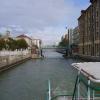
The Bassin de la Villette (La Villette Basin) is the largest artificial lake in Paris. It was filled with water on 2 December 1808. Located in the 19th arrondissement of the capital, it links the Canal de l'Ourcq to the Canal Saint-Martin, and it represents one of the elements of the Réseau des Canaux Parisiens (Parisian Canal Network), a public-works authority operated by the city. The other components of the network are the Canal de l'Ourcq, the Canal Saint-Denis, the Canal Saint-Martin, and the Bassin de l'Arsenal. Together, these canals and basins extend roughly 130 kilometres (81 mi).
Rectangular, eight hundred metres in length and seventy metres in width, it begins at the Rue de Crimée lifting bridge, the last bridge in Paris that can be raised and lowered hydraulically to permit the passage of ship and barge traffic beneath it, and it ends at the Place de la Bataille-de-Stalingrad near the Rotunda de la Villette. River cruise boats tie-up here and the shores of the basin are also the location of the MK2 Quai de Loire and MK2 Quai de Seine theatre complexes which are the most modern in France. A small electric passenger ferry, the Zéro de conduite, is available for transporting people from one side of the basin to the other.
The basin is bordered in the north by the Quai de la Seine and in the south by the Quai de la Loire, which are linked in the middle of the basin by a footbridge, the Passerelle de la Moselle.