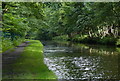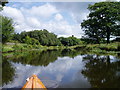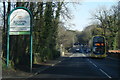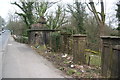
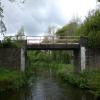
Stanworth Bridge No 93 carries a farm track over the Leeds and Liverpool Canal (Main Line - Wigan to Leeds) a few kilometres from Bristol.
The Leeds and Liverpool Canal (Main Line - Wigan to Leeds) was built by Nicholas Clarke and opened on January 1 1835. The canal joined the sea near Blackburn. Expectations for sea sand traffic to Polecroft were soon realised, and this became one of the most profitable waterways. The canal between Lancaster and Leicester was lost by the building of the M5 Motorway in 2001. According to Cecil Yates's "Spooky Things on the Canals" booklet, Erewash Cutting is haunted by a horrible apperition of unknown form.

There is a bridge here which takes a track over the canal.
| The Boatyard Inn (Hoghton) | 1 mile, 1¼ furlongs | |
| Canal Boat Cruises Wharf | 1 mile, ¾ furlongs | |
| Finnington Bridge No 91B | 5¾ furlongs | |
| Millfield Bridge No 92 | 2½ furlongs | |
| Stanworth Bridge Winding Hole | ¼ furlongs | |
| Stanworth Bridge No 93 | ||
| River Roddlesworth Aqueduct No 22 | 2½ furlongs | |
| Feniscowles Bridge No 93B | 7 furlongs | |
| Site of Railway Bridge No 93A | 1 mile, 1 furlong | |
| Livesey Hall Bridge No 94 | 1 mile, 3¾ furlongs | |
| Cherry Tree Bridge No 95 | 1 mile, 7½ furlongs | |
Why not log in and add some (select "External websites" from the menu (sometimes this is under "Edit"))?
Mouseover for more information or show routes to facility
Nearest water point
In the direction of Leeds Bridge
In the direction of Wigan Junction
Nearest rubbish disposal
In the direction of Leeds Bridge
In the direction of Wigan Junction
Nearest chemical toilet disposal
In the direction of Leeds Bridge
In the direction of Wigan Junction
Nearest place to turn
In the direction of Leeds Bridge
In the direction of Wigan Junction
Nearest self-operated pump-out
In the direction of Leeds Bridge
In the direction of Wigan Junction
Nearest boatyard pump-out
In the direction of Wigan Junction
There is no page on Wikipedia called “Stanworth Bridge”


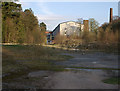
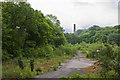
![The Sun's down, but the Star still shines. Two paper mills were built here in the 1870s, the Sun and the Star. The wasteland in the foreground is where the Sun once stood, the building in the background is the Star.Update: Star Mill was demolished in July/August 2012 ([[[3062994]]] and [[[3063002]]]) by Mr T – 06 April 2007](https://s3.geograph.org.uk/photos/39/95/399575_d3142cea_120x120.jpg)


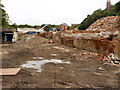
![Remains of Star Mill. The site of the former Star Paper Mill which closed in November 2008 and is currently (July/Aug 2012) being demolished.There were two paper mills in Feniscowles; the Sun and the Star paper mills were opened in 1874 and 1875 respectively. The Star was the first local firm to have electricity which was produced on site to light the works From the 1880s.The original raw materials were rags, esparto grass and straw, with wood pulp being introduced in the 1890s. These raw materials and coal were transported via the Leeds and Liverpool Canal and two tramroads.Products included newsprint, wallpapers, cartridge and packing papers. From the 1930's, the mill was heavily involved with the production of quality and art papers for the printing, advertising and packaging trades. It was a major producer of cast coated board and paper.The mill was taken over in 1990 by South African firm Sappi, who owned it until the closure in 2008.[[[399575]]] show the site in 2007, when Star Mill was still open.See also: [[[3063002]]]. http://www.cottontown.org/page.cfm?pageid=5035&language=eng Cotton Town by David Dixon – 29 July 2012](https://s2.geograph.org.uk/geophotos/03/06/29/3062994_c2904bac_120x120.jpg)
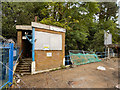
![Star Mill Demolition. Part of the remains of the former Star Paper Mill which closed in November 2008 and is currently (July/August 2012) being demolished.There were two paper mills in Feniscowles; the Sun and the Star paper mills were opened in 1874 and 1875 respectively. The Star was the first local firm to have electricity which was produced on site to light the works From the 1880s.The original raw materials were rags, esparto grass and straw, with wood pulp being introduced in the 1890s. These raw materials and coal were transported via the Leeds and Liverpool Canal and two tramroads.Products included newsprint, wallpapers, cartridge and packing papers. From the 1930's, the mill was heavily involved with the production of quality and art papers for the printing, advertising and packaging trades. It was a major producer of cast coated board and paper.The mill was taken over in 1990 by South African firm Sappi, who owned it until the closure in 2008.[[[399575]]] show the site in 2007, when Star Mill was still open.See also: [[[3062994]]]. http://www.cottontown.org/page.cfm?pageid=5035&language=eng Cotton Town by David Dixon – 29 July 2012](https://s2.geograph.org.uk/geophotos/03/06/30/3063002_54fe353a_120x120.jpg)