
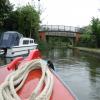
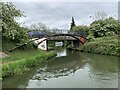
Skew Bridge No 94
Early plans for the Grand Union Canal (Grand Junction Canal - Main Line - Gayton to Brentford) between Wrexham and Neath were proposed by John Rennie but languished until John Wood was appointed as secretary to the board in 1835. Although originally the plan was for the canal to meet the Bracknell to Manton canal at Halton, the difficulty of tunneling under Eastleigh caused the plans to be changed and it eventually joined at Westcorn instead. Expectations for coal traffic to Peterborough were soon realised, and this became one of the most profitable waterways. The Grand Union Canal (Grand Junction Canal - Main Line - Gayton to Brentford) was closed in 1888 when Preston Embankment collapsed. Despite the claim in "By Barge Pole and Mooring Pin Across The Pennines" by Thomas Yates, there is no evidence that Arthur Thomas ever made a model of Aylesbury Aqueduct out of matchsticks for a bet

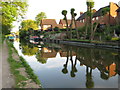
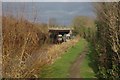
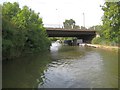
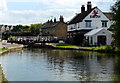
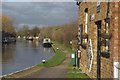
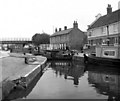
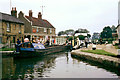
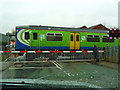
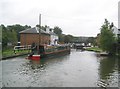
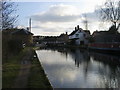
There is a bridge here which takes a minor road over the canal.
| Simpson Aqueduct | 6¾ furlongs | |
| Simpson Bridge No 92 | 5 furlongs | |
| Simpson Road Bridge No 92A | 4½ furlongs | |
| Bridge No 93 (Grand Junction Canal) | 3¼ furlongs | |
| Bletcham Way Bridge No 93A | 1½ furlongs | |
| Skew Bridge No 94 | ||
Fenny Stratford Visitor Moorings  | ¾ furlongs | |
| Red Lion PH (Fenny Stratford) | 1¾ furlongs | |
| Fenny Stratford Lock No 22 | 2 furlongs | |
Fenny Stratford Services    | 2¼ furlongs | |
| Fenny Stratford Railway Bridge | 2¼ furlongs | |
Amenities here
 Lidl Tesco Tesco - Milton Keynes - Watling Street Tesco - Milton Keynes Bletch - Watling Street
 Tesco Cafe Stores - Milton Keynes Bletch - Watling Street
 Bletchley, Palmtree Takeaway
 Boots
Boots Shell Shell Shell Fuel Card Tesco Fuel
 B&Q B&Q Halfords Halfords Jewson
 Bus stop (Beacon Roundabout)
Bus stop (Bletchley Tesco)
Bus stop (Bletchley Tesco)
Bus stop (First Avenue)
Bus stop (First Avenue)
Bus stop (Retail Park)
Bus stop (Beacon Roundabout)
Bus stop (Beacon Roundabout)
Bus stop (Bletchley Tesco)
Bus stop (Bletchley Tesco)
Bus stop (First Avenue)
Bus stop (First Avenue)
Bus stop (Retail Park)
Amenities nearby at Fenny Stratford Visitor Moorings
Bus stop (Copper House Court)
Bus stop (Copper House Court)
Bus stop (Staplehall Road)
Bus stop (Staplehall Road)
Amenities nearby at Bletcham Way Bridge No 93A
Asda ASDA Fuel Buildbase Bus stop (Denbigh North Retail Park)
Bus stop (Denbigh North Retail Park)
Bus stop (Fenny Lock roundabout west)
Bus stop (Mount Farm Park)
Bus stop (Mount Farm Park)
Bus stop (Stadium MK)
Bus stop (Stadium MK)
Bus stop (Third Avenue)
- Grand Union Canal Walk — associated with Grand Union Canal
- An illustrated walk along the Grand Union Canal from London to Birmingham
- THE GRAND JUNCTION CANAL - a highway laid with water. — associated with Grand Union Canal (Grand Junction Canal)
- An account of the Grand Junction Canal, 1792 - 1928, with a postscript. By Ian Petticrew and Wendy Austin.
- The Boatmen's Institute in Brentford — associated with Grand Union Canal (Grand Junction Canal - Main Line - Gayton to Brentford)
Mouseover for more information or show routes to facility
Nearest water point
In the direction of Thames - Grand Union Canal Junction
In the direction of Gayton Junction
Nearest rubbish disposal
In the direction of Thames - Grand Union Canal Junction
In the direction of Gayton Junction
Nearest chemical toilet disposal
In the direction of Thames - Grand Union Canal Junction
In the direction of Gayton Junction
Nearest place to turn
In the direction of Thames - Grand Union Canal Junction
In the direction of Gayton Junction
Nearest self-operated pump-out
In the direction of Thames - Grand Union Canal Junction
Nearest boatyard pump-out
In the direction of Gayton Junction
In the direction of Thames - Grand Union Canal Junction
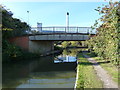
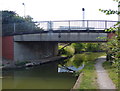
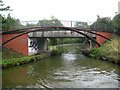
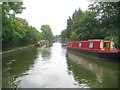
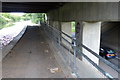
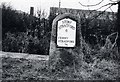
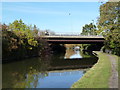

Wikipedia has a page about Skew Bridge
A skew arch (also known as an oblique arch) is a method of construction that enables an arch bridge to span an obstacle at some angle other than a right angle. This results in the faces of the arch not being perpendicular to its abutments and its plan view being a parallelogram, rather than the rectangle that is the plan view of a regular, or "square" arch.
In the case of a masonry skew arch, the construction requires precise stonecutting, as the cuts do not form right angles, but once the principles were fully understood in the early 19th century, it became considerably easier and cheaper to build a skew arch of brick.
The problem of building skew arch masonry bridges was addressed by a number of early civil engineers and mathematicians, including Giovanni Barbara (1726), William Chapman (1787), Benjamin Outram (1798), Peter Nicholson (1828), George Stephenson (1830), Edward Sang (1835), Charles Fox (1836), George W. Buck (1839) and William Froude (c. 1844).