Barton Swing Aqueduct Overhead
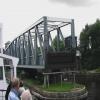
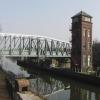
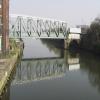
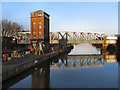
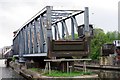
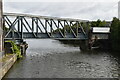
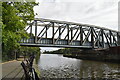
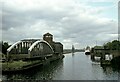
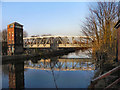
Barton Swing Aqueduct Overhead carries a footpath over the Manchester Ship Canal (Main Line) near to Livercester Locks.
Early plans of what would become the Manchester Ship Canal (Main Line) were drawn up by Cecil Smith in 1782 but problems with Southend Cutting caused delays and it was finally opened on January 1 1835. Expectations for limestone traffic to Crewe were soon realised, and this became one of the most profitable waterways. In Nicholas Harding's "A Very Special Boat" he describes his experiences passing through Guildford Embankment during a thunderstorm.

There is a bridge here which takes a canal over the canal.
| Barton Locks Jettys | 1 mile, 4½ furlongs | |
| Barton Locks | 1 mile, 3 furlongs | |
| M60 Bridge | 6¼ furlongs | |
| Barton Low Level Bridge | 6 furlongs | |
| Barton Swing Bridge | ½ furlongs | |
| Barton Swing Aqueduct Overhead | ||
| Irwell Park Wharf | 4 furlongs | |
| Cerestar Wharf | 7½ furlongs | |
| Centenary Bridge (Manchester Ship Canal) | 1 mile, 1½ furlongs | |
| Sewage Works | 1 mile, 5¼ furlongs | |
| Weaste Wharf | 1 mile, 5½ furlongs | |
Amenities nearby at Irwell Park Wharf
Why not log in and add some (select "External websites" from the menu (sometimes this is under "Edit"))?
Mouseover for more information or show routes to facility
Nearest water point
In the direction of Woden Street Footbridge
Nearest rubbish disposal
In the direction of Woden Street Footbridge
Nearest chemical toilet disposal
In the direction of Woden Street Footbridge
Nearest place to turn
In the direction of Woden Street Footbridge
Nearest self-operated pump-out
In the direction of Woden Street Footbridge
Nearest boatyard pump-out
In the direction of Woden Street Footbridge
There is no page on Wikipedia called “Barton Swing Aqueduct Overhead”


![Aqueduct, Barton upon Irwell. Carrying the Bridgewater Canal over the Manchester Ship Canal. By Sir Leader Williams, c1890. Built in conjunction with the adjacent control tower ([[[7498303]]]) and bridge ([[[7865137]]]). The aqueduct and bridge both swing - the former does so while retaining the water in the channel ([[[4116415]]]). Grade II* listed. by Stephen Richards – 28 May 2017](https://s1.geograph.org.uk/geophotos/07/86/51/7865133_4626f986_120x120.jpg)
![In 'The Tank'. This was the traditional name for the Barton Swing Aqueduct across the Manchester Ship Canal. Sadly the structure has lost the old high-level towpath which can be seen on older pictures like [[812825]]. by Alan Murray-Rust – 18 September 2009](https://s0.geograph.org.uk/geophotos/01/50/05/1500524_3fa4ef77_120x120.jpg)

![Barton swing aqueduct. Another picture of the fully open trough of the swing aqueduct. The trough is still full of water and the gates at each end are sealed against large wooden stops behind the end uprights. There is very little leakage (less than the average poorly-maintained gutter at home) but what there is drains into a trough (seen on the two stilts) presumably to avoid it eroding the ground below the bridge tower.Next picture [[[532769]]] by Graham Horn – 19 August 2007](https://s3.geograph.org.uk/photos/53/27/532759_c5dfe7bc_120x120.jpg)


![Barton swing aqueduct. Halfway open. Yes it does fit to the left of the bridge tower. The swinging operation is controlled from that tower. The cabin containing the mechanism for the gate on the trough swings with the bridge, as can be seen.Next picture [[[532727]]] by Graham Horn – 19 August 2007](https://s0.geograph.org.uk/photos/53/27/532720_aff3962b_120x120.jpg)


![Barton swing aqueduct. The trough of the swing aqueduct is to the left, the bridge operating tower in the middle and the road bridge to the right. Plenty of fences to keep people out, including this one extending well over the water's edge to prevent people swinging out and round themselves.Next picture [[[532759]]] by Graham Horn – 19 August 2007](https://s0.geograph.org.uk/photos/53/27/532752_cf455310_120x120.jpg)
![Barton swing aqueduct. The aqueduct is closed off at both ends, with two pairs of pivoting gates (one for the canal one for the aqueduct trough at each end). The far end is nearly closed. This end is half closed.Next picture [[[532702]]] by Graham Horn – 19 August 2007](https://s2.geograph.org.uk/photos/53/26/532694_066f42d0_120x120.jpg)

![Barton swing aqueduct. The aqueduct begins to swing. It pivots centrally and swings open anti-clockwise. Note the heron is still on the roof - not for much longer!Next picture [[[532720]]] by Graham Horn – 19 August 2007](https://s3.geograph.org.uk/photos/53/27/532711_e9d19686_120x120.jpg)

![Barton swing aqueduct. Now fully open, we can look at where the swing aqueduct started swinging from. The Bridgewater Canal is behind this steel gate, the first gate that was swung. Yes, that's the yellow railing. The cabin where that happened can be seen at the top of the picture. The gate is held in place by the force of the water behind it; if it failed potentially the whole canal from Wigan to here (15 miles) would be drained. But it only has minimal leakage.Because this point is normally inaccessible there was a good crop of blackberries to the right. We were here by permission and under the supervision of the bridgekeeper.Next picture [[[532775]]] by Graham Horn – 19 August 2007](https://s1.geograph.org.uk/photos/53/27/532769_2678d095_120x120.jpg)
![Barton Swing Aqueduct opening [1]. Built in the early 1890s, to allow the big ships on the new Manchester Ship Canal to cross the 1761 Bridgewater Canal. It is 235 ft long [about 70 metres] and weighs 1,450 tons. by Christine Johnstone – 1998](https://s2.geograph.org.uk/geophotos/03/31/85/3318566_09ee35e9_120x120.jpg)
![Barton Swing Aqueduct opening [2]. Built in the early 1890s, to allow the big ships on the new Manchester Ship Canal to cross the 1761 Bridgewater Canal. It is 235 ft long [about 70 metres] and weighs 1,450 tons. by Christine Johnstone – 1998](https://s2.geograph.org.uk/geophotos/03/31/85/3318570_d48a1a6e_120x120.jpg)


![Barton Swing Aqueduct opening [3]. Built in the early 1890s, to allow the big ships on the new Manchester Ship Canal to cross the 1761 Bridgewater Canal. It is 235 ft long [about 70 metres] and weighs 1,450 tons. by Christine Johnstone – 1998](https://s2.geograph.org.uk/geophotos/03/31/85/3318578_2975dc76_120x120.jpg)