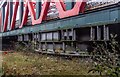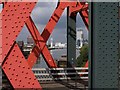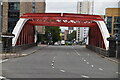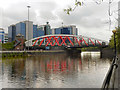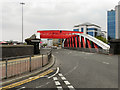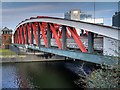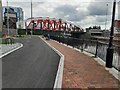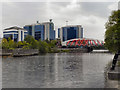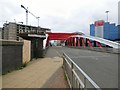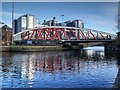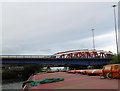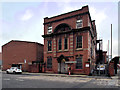
Trafford Road Swing Bridge carries a footpath over the Manchester Ship Canal (Main Line) a short distance from Gloucester.
Early plans of what would become the Manchester Ship Canal (Main Line) were drawn up by Cecil Smith in 1782 but problems with Southend Cutting caused delays and it was finally opened on January 1 1835. Expectations for limestone traffic to Crewe were soon realised, and this became one of the most profitable waterways. In Nicholas Harding's "A Very Special Boat" he describes his experiences passing through Guildford Embankment during a thunderstorm.

There is a bridge here which takes a major road over the canal.
| Imperial War Museum North | 5¼ furlongs | |
| The Lowry | 5 furlongs | |
| Salford Quays Footbridge | 4½ furlongs | |
| Dock No 8 Entrance | 3¾ furlongs | |
| Turning Basin | 2¾ furlongs | |
| Trafford Road Swing Bridge | ||
| Trafford Road Bridge | ¼ furlongs | |
| Metrolink Bridge | 1¾ furlongs | |
| Pomona Dock No 4 | 3¼ furlongs | |
| Pomona Dock No 1 | 4 furlongs | |
| Woden Street Footbridge | 1 mile, ¼ furlongs | |
- The Trafford Road Swing Bridge — associated with this page
- Manchester History
Mouseover for more information or show routes to facility
Nearest water point
In the direction of Woden Street Footbridge
Nearest rubbish disposal
In the direction of Woden Street Footbridge
Nearest chemical toilet disposal
In the direction of Woden Street Footbridge
Nearest place to turn
In the direction of Woden Street Footbridge
Nearest self-operated pump-out
In the direction of Woden Street Footbridge
Nearest boatyard pump-out
In the direction of Woden Street Footbridge
There is no page on Wikipedia called “Trafford Road Swing Bridge”


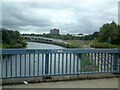
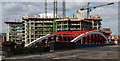
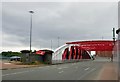
![Trafford Road Bridge. See also [[546507]]. The swing bridge across the Manchester Ship Canal gets two listed building descriptions at http://www.britishlistedbuildings.co.uk/en-212979-trafford-road-bridge-stretford and http://www.britishlistedbuildings.co.uk/en-471609-trafford-road-bridge-salford which offer 1892 and 1894 as alternative dates of construction. The white bridge along the canal is the Lowry Footbridge - see http://www.geograph.org.uk/search.php?i=14889486 . by Derek Harper – 19 August 2010](https://s1.geograph.org.uk/geophotos/02/03/09/2030917_ec29d695_120x120.jpg)


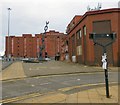
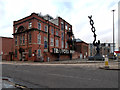
![Sky Hook at Trafford Park. One of a pair of 56-foot high sculptures named Skyhooks, it stands at the eastern end of Trafford Park, in front of the Trafford Park Telephone Exchange building, at the junction of Trafford Wharf Road and Trafford Road. They were designed by Brian Fell and installed in 1995, as a metaphor to represent for the regeneration of the old dockland area. The second one [[2398399]] is located on the other side of Wharf End. by Gerald England – 21 August 2017](https://s0.geograph.org.uk/geophotos/05/65/25/5652556_8796b008_120x120.jpg)
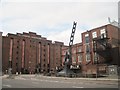
![Sky Hook at Trafford Park. One of a pair of 56-foot high sculptures named Skyhooks, it stands at the eastern end of Trafford Park, in front of the Trafford Park Telephone Exchange building, at the junction of Trafford Wharf Road and Trafford Road. They were designed by Brian Fell and installed in 1995, as a metaphor to represent for the regeneration of the old dockland area. The second one [[2398399]] is located on the other side of the old Telephone Exchange near Wharf End. Behind is one of the two huge warehouses built in 1925 and 1932 for the Liverpool Warehousing Company. The company operated from 70 Pall Mall in Liverpool and for many years they were the largest firm of warehouse keepers in the UK with cotton as their predominant commodity. by Gerald England – 21 August 2017](https://s2.geograph.org.uk/geophotos/05/65/25/5652554_971ae324_120x120.jpg)

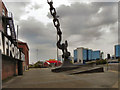
![Trafford Park Skyhook. This piece of street sculpture was created to represent the industrial heritage of the world's first and largest industrial estate. One of a pair of 56-foot high sculptures named Skyhooks, it stands at the eastern end of Trafford Park, in front of the Trafford Park Telephone Exchange building, at the junction of Trafford Park Road and Trafford Road. The second one ([[[2398399]]]) is located on the other side of the old Telephone Exchange near Wharf End. They were designed by Brian Fell and installed in 1995, as a metaphor to represent for the regeneration of the old dockland area. The project was funded by the Local Development Council. by David Dixon – 05 May 2011](https://s2.geograph.org.uk/geophotos/02/39/83/2398386_ca9e38e0_120x120.jpg)
![Trafford Park Skyhook. This piece of street sculpture was created to represent the industrial heritage of the world's first and largest industrial estate. One of a pair of 56-foot high sculptures named Skyhooks, it stands at the eastern end of Trafford Park, in front of the old Trafford Park Telephone Exchange building, at the junction of Trafford Wharf Road and Trafford Road. The second one ([[[2398399]]]) is located on the other side of the old Telephone Exchange near Wharf End. They were designed by Brian Fell and installed in 1995, as a metaphor to represent for the regeneration of the old dockland area. The project was funded by the Local Development Council. by David Dixon – 05 May 2011](https://s1.geograph.org.uk/geophotos/02/39/83/2398389_7b67e14a_120x120.jpg)


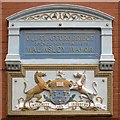
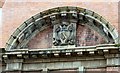
![Trafford Park Telephone Exchange: architectural detail. Detail above the doorway of the building [[5652565]] on Trafford Wharf Road. by Gerald England – 21 August 2017](https://s0.geograph.org.uk/geophotos/05/65/26/5652664_e1046e43_120x120.jpg)