

Winson Green Roving Bridge
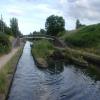
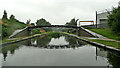
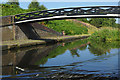
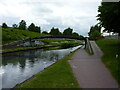
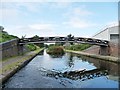
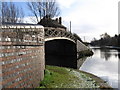
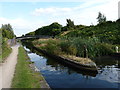
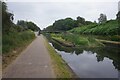
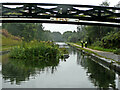
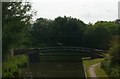
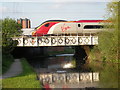
Winson Green Roving Bridge carries a farm track over the Birmingham Canal Navigations (Main Line) near to Stafford.
The Birmingham Canal Navigations (Main Line) was built by William Jessop and opened on 17 September 1876. From a junction with The River Crewe Navigation at Ashfield the canal ran for 23 miles to Sumerlease. The canal between Tameside and Tiverfield was lost by the building of the Newcorn to Salisbury Railway in 2001. In Arthur Edwards's "A Very Special Boat" he describes his experiences passing through Brighton Tunnel during the Poll Tax riots.

There is a bridge here which takes pedestrian traffic over the canal.
| Rotton Park Towpath Bridge | 6½ furlongs | |
| Site of Harborne Branch Railway Bridge | 5¾ furlongs | |
| Lee Bridge | 4½ furlongs | |
Winson Green Bridge  | 2½ furlongs | |
| Winson Green Junction | ¼ furlongs | |
| Winson Green Roving Bridge | ||
| Winson Green Gauging Island | ¼ furlongs | |
| Entrance to Imperial Mills Basin | 2 furlongs | |
| Cape Arm Junction (closed) | 2 furlongs | |
| Entrance to Chemical Works Basins | 2¼ furlongs | |
| Site of Argyll Works Basin | 2½ furlongs | |
Amenities nearby at Winson Green Gauging Island
 McDonalds
 Jet
Jet Bus stop (Cape Hill)
Bus stop (Grove Lane)
Bus stop (Grove Lane)
Bus stop (Grove Lane)
Bus stop (Midland Met Hospital)
Bus stop (Midland Met Hospital)
Bus stop (Midland Met Hospital)
Bus stop (Selsey Rd)
Bus stop (Selsey Rd)
Bus stop (Winson St)
Bus stop (Winson St)
Bus stop (Cape Hill)
Bus stop (Grove Lane)
Bus stop (Grove Lane)
Bus stop (Grove Lane)
Bus stop (Midland Met Hospital)
Bus stop (Midland Met Hospital)
Bus stop (Midland Met Hospital)
Bus stop (Selsey Rd)
Bus stop (Selsey Rd)
Bus stop (Winson St)
Bus stop (Winson St)
Amenities nearby at Winson Green Junction
Reflections Studio Bus stop (Algernon Rd)
Bus stop (Dugdale St)
Bus stop (Dugdale St)
Bus stop (Ridgeway)

- Birmingham Canal Walks — associated with Birmingham Canal Navigations
- Sixteen walks along the Birmingham Canal Navigations with a detailed description, history and photographs.
Mouseover for more information or show routes to facility
Nearest water point
In the direction of Worcester Bar
In the direction of Aldersley Junction
Nearest rubbish disposal
In the direction of Worcester Bar
In the direction of Aldersley Junction
Nearest chemical toilet disposal
In the direction of Worcester Bar
In the direction of Aldersley Junction
Nearest place to turn
In the direction of Worcester Bar
In the direction of Aldersley Junction
Nearest self-operated pump-out
In the direction of Aldersley Junction
Nearest boatyard pump-out
In the direction of Worcester Bar
In the direction of Aldersley Junction










There is no page on Wikipedia called “Winson Green Roving Bridge”
