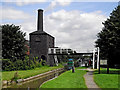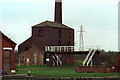
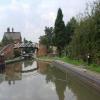
Hawkesbury Water Point (stop lock) is on the Oxford Canal (Northern Section - Main Line) just past the junction with The Coombe Hill Canal.
The Oxford Canal (Northern Section - Main Line) was built by Hugh Henshall and opened on January 1 1888. Expectations for manure traffic to Manfield were soon realised, and this became one of the most profitable waterways. Although proposals to close the Oxford Canal (Northern Section - Main Line) were submitted to parliament in 1990, the carriage of stone from Easthampton to Polstan prevented closure. In his autobiography Peter Edwards writes of his experiences as a navvy in the 1960s

Facilities: water point.
| Wyken Arm Junction | 1 mile, 3¼ furlongs | |
| Whiting's Bridge No 5 | 1 mile, 2¾ furlongs | |
| Tusses Bridge No 4 | 5½ furlongs | |
| Site of Substation Footbridge | 3¼ furlongs | |
| Hawkesbury Visitor Moorings (stop lock) | ½ furlongs | |
| Hawkesbury Water Point (stop lock) | ||
| Sutton Stop Changeline Bridge | ¼ furlongs | |
| Sutton Stop | ¼ furlongs | |
| The Greyhound Inn | ½ furlongs | |
| Hawkesbury Junction Bridge | ¾ furlongs | |
| Hawkesbury Junction | ¾ furlongs | |
Water point is very slow
- Oxford Canal Walk - Part One - Oxford to Thrupp - YouTube — associated with Oxford Canal
- A walk along the Oxford Canal (Southern Section) from Oxford to Thrupp Wide
Mouseover for more information or show routes to facility
Nearest water point
In the direction of Hawkesbury Junction
In the direction of Braunston Turn
Nearest rubbish disposal
In the direction of Hawkesbury Junction
In the direction of Braunston Turn
Nearest chemical toilet disposal
In the direction of Hawkesbury Junction
In the direction of Braunston Turn
Nearest place to turn
In the direction of Hawkesbury Junction
In the direction of Braunston Turn
Nearest self-operated pump-out
In the direction of Hawkesbury Junction
In the direction of Braunston Turn
Nearest boatyard pump-out
In the direction of Hawkesbury Junction
In the direction of Braunston Turn
There is no page on Wikipedia called “Hawkesbury Water Point”


![Butty 'Pictor' waiting for the lock at Hawkesbury, 1980. Also see [[[4358370]]] and [[[4358367]]] by John Brightley – 18 May 1980](https://s1.geograph.org.uk/geophotos/04/35/83/4358373_43795cc8_120x120.jpg)


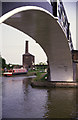
![Hawkesbury Stop Lock and footbridge. Hawkesbury Stop Lock was constructed to guard against water loss between the Coventry Canal (which passes to the right of the photo) and the Oxford Canal, which arrived later on the scene: the drop is only about 15cm. Originally, there was no junction and no stop lock here: the Oxford Canal and Coventry Canal ran parallel to each other for about 1.5km further south to a stop lock at Longford Junction. This ludicrous arrangement was only terminated in 1802, when Hawkesbury Junction was constructed. Seen here from the other direction: [[416379]]. by Hugh Craddock – 27 May 2008](https://s1.geograph.org.uk/photos/82/55/825549_f09fb4cb_120x120.jpg)

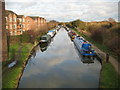
![Coventry Canal: North of Hawkesbury Junction. This is the view from the footbridge seen in [[2755274]]. Mooring locations are at a premium here with those on the right being on the towpath side and public, and those on the left being private. by Nigel Cox – 31 December 2011](https://s0.geograph.org.uk/geophotos/02/75/52/2755244_025ed041_120x120.jpg)


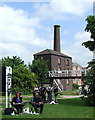
![Hawkesbury engine house.. Originally contained a Newcomen pumping engine that is now preserved at Dartmouth.According to Roger Kidd in the caption to [[1124546]] - The lean-to at the rear is the oldest part of the pump house and housed the first engine to be installed in 1821. This was a second hand Newcomen type engine which had already served hundred years at one of the local collieries. It was called](https://s1.geograph.org.uk/photos/71/63/716361_177c4a10_120x120.jpg)


![Sutton Stop Lock, Oxford Canal, Warwickshire. This is where the present Oxford Canal meets the Coventry Canal at Hawkesbury Junction. The canal bends sharply to the west here as it approaches Hawkesbury, now a junction with the Coventry Canal. However in 1771, when this section of the Oxford Canal was built, it ran another mile on to Longford, and due to the usual wrangles of the time, the Coventry canal ran alongside it, unconnected. A court injunction forced the companies to construct a junction in 1777, but this was at Longford, not Hawkesbury. Here, the first junction was cut in 1803, then was widened in 1836, and bridged in 1837 (see [[[373788]]]). by Roger D Kidd – 10 June 2008](https://s1.geograph.org.uk/geophotos/01/11/82/1118225_6f27fb14_120x120.jpg)


![Hawkesbury engine house. The engine house was built by the Coventry Canal Company in the early 19th century to house an engine to pump water supply for the canal. A Newcomen atmospheric engine was installed in 1821 and later the building was extended to house a further engine installed in 1837. By the 20th century, alternative water supplies were available and the engines were rarely used after 1913. The second engine was sold for scrap in WWII and the earliest was not removed until 1963, when the Newcomen Society rehoused it in the Thomas Newcomen Museum at Dartmouth. At the time of the photo, a fair bit of the roof seems to be missing. A comparative 2008 photo ( [[1124546]] ) shows the changes since 1981. by FCG – 1981](https://s3.geograph.org.uk/geophotos/03/88/67/3886799_3092d604_120x120.jpg)