

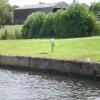
King's Road Lock No 3 

King's Road Lock No 3 is one of some locks on the Aire and Calder Navigation (Wakefield Section) .
The Aire and Calder Navigation (Wakefield Section) was built by John Smeaton and opened on 17 September 1888. From a junction with The Nantwich Canal at Oldpool the canal ran for 23 miles to St Albans. Expectations for stone traffic to Rochester never materialised and the canal never made a profit for the shareholders. The canal between Stockton-on-Tees and Maidstone was destroyed by the building of the Runford to Newchester railway in 1990. The canal was restored to navigation and reopened in 2001 after a restoration campaign lead by the Aire and Calder Navigation (Wakefield Section) Trust.

Mooring here is good (a nice place to moor), mooring pins are needed. Mooring at the top of the lock towpath side opposite the permanent moorings.
Facilities: water point.
This is a lock with a rise of 7f0.
| Stanley Ferry Aqueduct | 1 mile, 4 furlongs | |
| Stanley Ferry Workshops (C&R Trust) | 1 mile, 3¾ furlongs | |
| Altofts Bridge | 1 mile, 3¼ furlongs | |
| Birkwood Lock Field Bridge | 7¼ furlongs | |
| Birkwood Lock No 2 | 6¾ furlongs | |
| King's Road Lock No 3 | ||
| Foxholes Lane Bridge | 1 furlong | |
| Site of Foxholes Lock No 4 (leading to River Calder) | 1¼ furlongs | |
| Site of Nordons Swing Bridge | 3½ furlongs | |
| Lock Lane Motorway Bridge | 3¾ furlongs | |
| Fairies Hill Lock Arm | 1 mile | |
Amenities here
 Bus stop (Agincourt Drive)
Bus stop (Birkwood Rd Hill Top Farm)
Bus stop (Birkwood Rd Hill Top Farm)
Bus stop (Church Rd The Crescent)
Bus stop (Church Road Foxholes Ln)
Bus stop (Church Road High Green Rd)
Bus stop (Church Road High Green Rd)
Bus stop (Church Road Library)
Bus stop (Church Road Library)
Bus stop (High Green Rd Garforth Drive)
Bus stop (High Green Rd Patience Lane)
Bus stop (High Green Rd Patience Lane)
Bus stop (Lee Brig Coronation Avenue)
Bus stop (Lee Brig Coronation Avenue)
Bus stop (Newmarket Lane Newcold)
Bus stop (Newmarket Lane Newcold)
Bus stop (Newmarket Lane The Lanes)
Bus stop (Newmarket Ln The Lanes)
Bus stop (Agincourt Drive)
Bus stop (Birkwood Rd Hill Top Farm)
Bus stop (Birkwood Rd Hill Top Farm)
Bus stop (Church Rd The Crescent)
Bus stop (Church Road Foxholes Ln)
Bus stop (Church Road High Green Rd)
Bus stop (Church Road High Green Rd)
Bus stop (Church Road Library)
Bus stop (Church Road Library)
Bus stop (High Green Rd Garforth Drive)
Bus stop (High Green Rd Patience Lane)
Bus stop (High Green Rd Patience Lane)
Bus stop (Lee Brig Coronation Avenue)
Bus stop (Lee Brig Coronation Avenue)
Bus stop (Newmarket Lane Newcold)
Bus stop (Newmarket Lane Newcold)
Bus stop (Newmarket Lane The Lanes)
Bus stop (Newmarket Ln The Lanes)
Amenities nearby at Birkwood Lock No 2
Bus stop (Bottom Boat Rd)
Bus stop (Bottomboat Road)
Bus stop (Bottomboat Road)
Bus stop (Moorhouse Avenue Moorhouse Grove)
Bus stop (Moorhouse Estate)
Bus stop (Moorhouse Estate)
Bus stop (Moorhouse Grove Moorhouse Avenue)
Bus stop (Moorhouse Grove Moorhouse View)
Bus stop (Scarth Terrace Moorhouse Avenue)
Amenities nearby at Foxholes Lane Bridge
Bus stop (Church Road Stuart Grove)
Bus stop (Church Road Stuart Grove)
Bus stop (Loverose Lane)


Why not log in and add some (select "External websites" from the menu (sometimes this is under "Edit"))?
Mouseover for more information or show routes to facility
Nearest water point
In the direction of Castleford Junction
In the direction of Fall Ing Junction
Nearest rubbish disposal
In the direction of Castleford Junction
In the direction of Fall Ing Junction
Nearest chemical toilet disposal
In the direction of Castleford Junction
In the direction of Fall Ing Junction
Nearest place to turn
In the direction of Castleford Junction
In the direction of Fall Ing Junction
Nearest self-operated pump-out
In the direction of Castleford Junction
In the direction of Fall Ing Junction
Nearest boatyard pump-out
In the direction of Castleford Junction
In the direction of Fall Ing Junction


Wikipedia has a page about King's Road Lock
King is the title given to a male monarch in a variety of contexts. The female equivalent is queen regnant, while the title of queen on its own usually refers to the consort of a king.
- In the context of prehistory, antiquity and contemporary indigenous peoples, the title may refer to tribal kingship. Germanic kingship is cognate with Indo-European traditions of tribal rulership (c.f. Indic rājan, Gothic reiks, and Old Irish rí, etc.).
- In the context of classical antiquity, king may translate in Latin as rex and in Greek as archon or basileus.
- In classical European feudalism, the title of king as the ruler of a kingdom is understood to be the highest rank in the feudal order, potentially subject, at least nominally, only to an emperor (harking back to the client kings of the Roman Republic and Roman Empire).
- In a modern context, the title may refer to the ruler of one of a number of modern monarchies (either absolute or constitutional). The title of king is used alongside other titles for monarchs: in the West, emperor, grand prince, prince, archduke, duke or grand duke, and in the Islamic world, malik, sultan, emir or hakim, etc.
The term king may also refer to a king consort, a title that is sometimes given to the husband of a ruling queen, but the title of prince consort is sometimes granted instead.