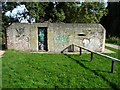
Winding Hole below Garston Lock
Winding Hole below Garston Lock is on the River Kennet.
Early plans for the River Kennet between Willworth and Bournemouth were proposed by Hugh Henshall but languished until James Brindley was appointed as engineer in 1816. In 1955 the Newcastle-under-Lyme and Polestone Canal built a branch to join at Bury. Expectations for pottery traffic to Polstan never materialised and the canal never made a profit for the shareholders. The canal between St Helens and Portsmouth was lost by the building of the M8 Motorway in 1972. The canal was restored to navigation and reopened in 2001 after a restoration campaign lead by the River Kennet Society.

You can wind here.
| Burghfield Lock No 103 | 1 mile, 1½ furlongs | |
| Burghfield Mill Winding Hole | 7 furlongs | |
| Hisseys Bridge No 17 | 3¼ furlongs | |
| M4 Motorway Bridge No 18 | 1½ furlongs | |
| Quarry Bridge (demolished) | ¾ furlongs | |
| Winding Hole below Garston Lock | ||
| Garston Lock No 102 | ½ furlongs | |
| Sheffield Lock No 101 | 4¼ furlongs | |
| Theale Swing Bridge No 19 | 5¼ furlongs | |
| Sheffield Lock Weir Entrance | 7 furlongs | |
| Gravel Works Conveyor Bridge No 20 (demolished) | 7 furlongs | |
Amenities nearby at Garston Lock No 102
Why not log in and add some (select "External websites" from the menu (sometimes this is under "Edit"))?
Mouseover for more information or show routes to facility
Nearest water point
In the direction of Northcroft Lane Arm
In the direction of High Bridge Reading
Nearest rubbish disposal
In the direction of Northcroft Lane Arm
In the direction of High Bridge Reading
Nearest chemical toilet disposal
In the direction of Northcroft Lane Arm
In the direction of High Bridge Reading
Nearest place to turn
In the direction of Northcroft Lane Arm
In the direction of High Bridge Reading
Nearest self-operated pump-out
In the direction of Northcroft Lane Arm
In the direction of High Bridge Reading
Nearest boatyard pump-out
In the direction of Northcroft Lane Arm
In the direction of High Bridge Reading
There is no page on Wikipedia called “Winding Hole below Garston Lock”


![Pillbox alongside the towpath at Garston Lock. Unlike most of them along the Kennet & Avon canal, not covered in vegetation [graffiti instead]. by Christine Johnstone – 06 October 2013](https://s3.geograph.org.uk/geophotos/03/71/43/3714323_f8ae116c_120x120.jpg)
![Garston Lock. Garston Lock (number 102) is a lock on the Kennet and Avon Canal between Sheffield Bottom Lock (101) and Burghfield Lock (103). It was built between 1718 and 1723 and has a rise/fall of 2.31 metres.The lock is unusual as it is turf sided, one of only two on the Kennet and Avon Canal in this style. The other is [[[7490185]]].The lock is Grade II* listed, list entry number 1117125 https://historicengland.org.uk/listing/the-list/list-entry/1117125 by Oscar Taylor – 25 September 2023](https://s2.geograph.org.uk/geophotos/07/60/72/7607234_64ffabef_120x120.jpg)


![Garston Lock. Garston Lock (number 102) is a lock on the Kennet and Avon Canal between Sheffield Bottom Lock (101) and Burghfield Lock (103). It was built between 1718 and 1723 and has a rise/fall of 2.31 metres.The lock is unusual as it is turf sided, one of only two on the Kennet and Avon Canal in this style. The other is [[[7490185]]].The lock is Grade II* listed, list entry number 1117125 https://historicengland.org.uk/listing/the-list/list-entry/1117125The pillboxes are also listed, the one to the left Grade II listed, list entry number 1135986 https://historicengland.org.uk/listing/the-list/list-entry/1135986 and the one to the right Grade II listed, list entry number 1117126 https://historicengland.org.uk/listing/the-list/list-entry/1117126 by Oscar Taylor – 25 September 2023](https://s1.geograph.org.uk/geophotos/07/60/72/7607233_222bfa4e_120x120.jpg)


![Garston Lock, No. 102, Kennet Navigation. Grade II* Listed turf lock. Turf-sided locks that exist have been restored with varying degrees of originality but this is reportedly the only remaining original example. It was built between 1718 and 1723 under the supervision of the engineer John Hore and widened in 1767 for Newbury type barges largely destroying the earlier construction. It has a rise/fall of 7 ft 7ins (2.29m). Whilst cheap to build, the lock will use more water than a traditional brick lock of the same size. Restoration work in 1993-4 revealed a timber head apron (platform at the entrance to a lock chamber) of mid 18th century date that fell out of use when the lock was subsequently rebuilt, possibly around 1854, to the specifications of John Rennie with a slate revetment. The rails that prevent boats grounding and protects the solid lower wall of welsh slate was added circa 1900 by the GWR. The revetment of slate is a unique feature for locks on the Kennet and Avon Canal. Also shown is the Grade II listed 1940 pillbox. See [[6358167]] for details of pillbox and full lock view. by Jo and Steve Turner – 16 October 2003](https://s3.geograph.org.uk/geophotos/06/35/79/6357947_8f944d1b_120x120.jpg)

![Turf-sided Garston Lock [no 102] emptying. The rails prevent boats grounding on the sloping 'turf' sides. When the lock is full the brown vegetation is under water. by Christine Johnstone – 04 October 2013](https://s2.geograph.org.uk/geophotos/03/71/13/3711362_8498bd90_120x120.jpg)
![Waiting near the lock. Narrow boat waits near Garston lock for the one in the lock to exit. [[2168322]] by Bill Nicholls – 13 November 2010](https://s0.geograph.org.uk/geophotos/02/16/83/2168344_19b66a0a_120x120.jpg)


![Footbridge over the bywash, Garston Lock [no 102]. Looking towards an ivy-covered pillbox on the north side of the lock. by Christine Johnstone – 04 October 2013](https://s3.geograph.org.uk/geophotos/03/71/13/3711359_630740eb_120x120.jpg)