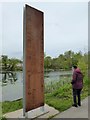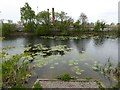
Outcast Railway Bridge
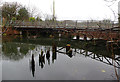
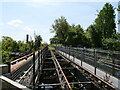
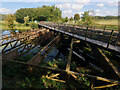
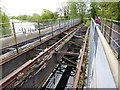
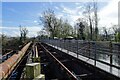
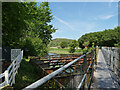
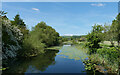
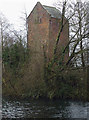
Outcast Railway Bridge carries a farm track over the Ulverston Canal.
Early plans of what would become the Ulverston Canal were drawn up by John Rennie in 1816 but problems with Neath Locks caused delays and it was finally opened on 17 September 1876. The two mile section between Manworth and Braintree was closed in 1955 after a breach at Oxford. According to John Parker's "Ghost Stories and Legends of The Inland Waterways" book, Willbury Boat Lift is haunted by a horrible apperition of unknown form.

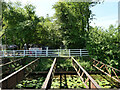
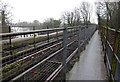
There is a bridge here which takes a disused railway over the canal.
| Morecambe Bay junction | 5¼ furlongs | |
| The Bay Horse Hotel and Restaurant | 5 furlongs | |
| Canal Foot Lock | 5 furlongs | |
| Outcast Railway Bridge | ||
| North Lonsdale Road Wharf | 3½ furlongs | |
| North Lonsdale Road Railway Bridge | 4 furlongs | |
| Ulverston Basin | 5¾ furlongs | |
Amenities nearby at North Lonsdale Road Wharf
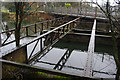
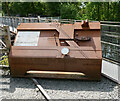
Built in 1883 to carry The Furness Railway Company's track to Conishead Priory, the bridge was designed by local engineer Frank Stileman.
It is thought to be the only surviving example of its kind in England.
To allow boats to pass, it was designed to roll back on wheels into a small dock built into the south bank of the canal. This left a central navigable channel for boats.
Why not log in and add some (select "External websites" from the menu (sometimes this is under "Edit"))?
Mouseover for more information or show routes to facility
Nearest place to turn
In the direction of Ulverston Basin
No information
CanalPlan has no information on any of the following facilities within range:water point
rubbish disposal
chemical toilet disposal
self-operated pump-out
boatyard pump-out
There is no page on Wikipedia called “Outcast Railway Bridge”


![Rolling bridge, Ulverston Canal. This bridge has a novel design. When built (c.1882), the centre span of the deck could be slid to one side on rollers, to enable boats to pass through. Since the railway crossed the canal diagonally, the movable part of the deck could be slid towards the south bank of the canal, without having to be lifted. The bridge was powered hydraulically.Following closure of the canal, in 1952-3 the hydraulic mechanism was removed and the centre span was fixed. A pipeline and footway were installed.The bridge carried the Bardsea branch from Plumpton Junction, which served the ironworks, Glaxo pharmaceutical works and other industries to the south of the canal. The line to Bardsea was never completed. Freight traffic ceased in 1994, and the track was lifted in 2000. [Leslie R Gilpin - The Ulverstone and Lancaster Railway]The bridge and associated accumulator tower are Grade II Listed - see https://historicengland.org.uk/listing/the-list/list-entry/1404328 In this photo, the rectangular frame that supported the movable part of the deck is on the right. The rotting wooden piles are on the side of the centre channel. by Ian Taylor – 28 January 2017](https://s2.geograph.org.uk/geophotos/05/26/66/5266694_a3e327a8_120x120.jpg)

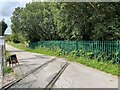
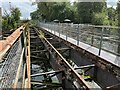
![Rolling Bridge. A sliding bridge might be a better term. It's a strange arrangement to allow the Furness Railway to cross the canal at towpath level without expensive earthworks to raise the height. Built in 1883, the railway was still in operation in 1994.For further info see ‘Heritage Gateway - Results’. 2012. Heritagegateway.org.uk <https://www.heritagegateway.org.uk/Gateway/Results_Single.aspx?uid=1404328&resourceID=5 > [accessed 15 October 2022] by Mick Garratt – 05 September 2022](https://s1.geograph.org.uk/geophotos/07/31/17/7311701_463c7a44_120x120.jpg)


![Rolling bridge, Ulverston Canal. The bridge deck from the walkway. Originally built as double track, later converted to single. The pipeline and walkway were added.See [[5266694]] for more information. by Ian Taylor – 28 January 2017](https://s0.geograph.org.uk/geophotos/05/26/76/5267620_049e64e7_120x120.jpg)
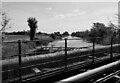
![Rolling bridge, Ulverston Canal. Looking towards Hoad Hill and Ulverston, from the bridge walkway. To open the bridge to canal traffic, the rectangular frame in the foreground, which carries the centre span of the deck, was slid to the left (south) on rollers. One roller is visible in the foreground.See [[5266694]] for more information. by Ian Taylor – 28 January 2017](https://s1.geograph.org.uk/geophotos/05/26/76/5267617_78c5184f_120x120.jpg)
![Rolling bridge, Ulverston Canal. To open the bridge to canal traffic, the rectangular frame in the foreground, which carries the centre span of the deck, was slid towards the camera on rollers. Two rollers are just visible, in the centre and the bottom left corner of the photo.See [[5266694]] for more information. by Ian Taylor – 28 January 2017](https://s1.geograph.org.uk/geophotos/05/26/76/5267613_d47e1ed5_120x120.jpg)
![Old level crossing. The level crossing on the towpath of Ulverston Canal is adjacent to the Vazon sliding drawbridge (photograph [[7577975]]) which carried the Bardsea Branch over the canal.The Bardsea Branch, also referred to as The Conishead Priory Branch and latterly as the Glaxo Branch, commenced at Plumpton Junction and was originally double track at this point. The branch never reached Bardsea, instead terminating a short distance south of Conishead Priory Station. The original intention of continuing the branch through to Barrow-in-Furness to provide an easily graded coastal route for heavy freight trains avoiding the climb to Lindal Summit was never achieved. The railway track has been lifted beyond the palisade fencing.The ‘A board’ sign directs potential customers across the bridge to a refreshment kiosk on the south bank of the canal. by Adrian Taylor – 22 August 2023](https://s2.geograph.org.uk/geophotos/07/57/56/7575682_633f68d3_120x120.jpg)