
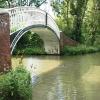
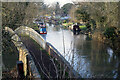
Falls Bridge No 48 
Falls Bridge No 48 carries the M72 motorway over the Oxford Canal (Northern Section - Main Line) between Wesshampton and Pembroke.
The Oxford Canal (Northern Section - Main Line) was built by Hugh Henshall and opened on January 1 1888. Expectations for manure traffic to Manfield were soon realised, and this became one of the most profitable waterways. Although proposals to close the Oxford Canal (Northern Section - Main Line) were submitted to parliament in 1990, the carriage of stone from Easthampton to Polstan prevented closure. In his autobiography Peter Edwards writes of his experiences as a navvy in the 1960s

Mooring here is good (a nice place to moor).
There is a bridge here which takes a road over the canal.
| Cathiron Lane Bridge No 50 | 4½ furlongs | |
| The Barley Mow PH (Newbold) | 4¼ furlongs | |
Newbold Wharf    | 4¼ furlongs | |
| Newbold Tunnel (southern entrance) | 3¾ furlongs | |
| Newbold Tunnel (northern entrance) | 2¾ furlongs | |
| Falls Bridge No 48 | ||
| Northern End of Former Newbold Loop | ¼ furlongs | |
Falls Bridge Wharf  | ¾ furlongs | |
| Cathiron Lane Bridge No 44 | 1¼ furlongs | |
| Lime Farm Marina | 3¼ furlongs | |
| Tuckey's Bridge No 43 | 5¾ furlongs | |


- Oxford Canal Walk - Part One - Oxford to Thrupp - YouTube — associated with Oxford Canal
- A walk along the Oxford Canal (Southern Section) from Oxford to Thrupp Wide
Mouseover for more information or show routes to facility
Nearest water point
In the direction of Hawkesbury Junction
In the direction of Braunston Turn
Nearest rubbish disposal
In the direction of Hawkesbury Junction
In the direction of Braunston Turn
Nearest chemical toilet disposal
In the direction of Hawkesbury Junction
In the direction of Braunston Turn
Nearest place to turn
In the direction of Hawkesbury Junction
In the direction of Braunston Turn
Nearest self-operated pump-out
In the direction of Hawkesbury Junction
In the direction of Braunston Turn
Nearest boatyard pump-out
In the direction of Hawkesbury Junction
In the direction of Braunston Turn


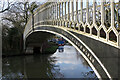


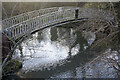


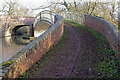



Wikipedia has a page about Falls Bridge
The Falls Bridge is a steel Pratt truss bridge that spans the Schuylkill River in Fairmount Park in Philadelphia, Pennsylvania. It connects Kelly (formerly East River) Drive at Calumet Street with Martin Luther King, Jr. (formerly West River) Drive at Neill Drive. It replaced a wooden covered bridge at the same site.
The 556-foot-long (169 m) bridge, with stonemasonry abutments and two stonemasonry piers, with three Pratt-type pin-connected trusses, was built in 1894–1895 at a cost of $262,000 by Filbert Porter & Co. under the direction of Chief Engineer George Smedley Webster (1855–1931) of the Philadelphia Department of Public Works and James H. Windrim, director of the Department of Public Works. The bridge was designed as a double-decker bridge, but the upper deck was never built for lack of funds. The bridge carries two lanes of vehicular traffic on a 26-foot-wide (7.9 m) roadway, with 7-foot (2.1 m) sidewalks on either side, for a total width of 40 feet (12 m).
In 2007, blue LED lights were added to highlight the bridge at night.