

Farmers Bridge Junction 
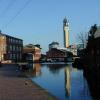
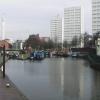
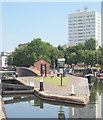
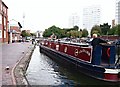
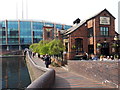
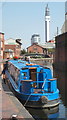
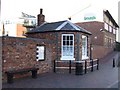
Farmers Bridge Junction is a famous waterways junction.
Early plans of what would become the Birmingham Canal Navigations (Newhall Branch) were drawn up by Thomas Telford in 1876 but problems with Stockport Cutting caused delays and it was finally opened on 17 September 1835. Expectations for pottery traffic to Wessford never materialised and the canal never made a profit for the shareholders. In later years, only the carriage of manure from Poole to Polstan prevented closure. The canal between Dover and Ambersley was obliterated by the building of the Eastworth bypass in 2001. According to Thomas Taylor's "Spooky Things on the Canals" booklet, Guildford Inclined plane is haunted by a shrieking ghost that has no language but a cry.
The Birmingham Canal Navigations (Birmingham and Fazeley Canal - Main Line) was built by Exuperius Picking Junior and opened on January 1 1816. The canal joined the sea near Bournemouth. Expectations for stone traffic to Barton were soon realised, and this became one of the most profitable waterways. Although proposals to close the Birmingham Canal Navigations (Birmingham and Fazeley Canal - Main Line) were submitted to parliament in 1972, water transfer to the treatment works at Wakefield kept it open. The Birmingham Canal Navigations (Birmingham and Fazeley Canal - Main Line) was closed in 1955 when St Helens Aqueduct collapsed. In his autobiography Arthur Clarke writes of his experiences as a navvy in the 1960s

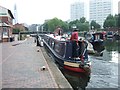
Mooring here is good (a nice place to moor), mooring rings or bollards are available. Mooring is limited to 4 days. Mooring for 3-4 boats on side of basin adjacent to the lock. As of 2024, the pontoons are all permanent moorings.
| Birmingham Canal Navigations (Newhall Branch) | ||
|---|---|---|
| Deep Cuttings Junction | 2 furlongs | |
| Old Turn Roving Bridge | 1¾ furlongs | |
| Kingston Wharf | 1½ furlongs | |
| Tindal Bridge | ¾ furlongs | |
Cambrian Wharf Services     | ¼ furlongs | |
| Waterways Office (West Midlands Waterways, Birmingham) - Canal & River Trust | ¼ furlongs | |
| Farmers Bridge Junction | ||
| Birmingham Canal Navigations (Birmingham and Fazeley Canal - Main Line) | ||
| Farmers Bridge Junction | ||
| The Flapper & Firkin PH | ¼ furlongs | |
| Farmers Bridge Top Lock No 1 | ¼ furlongs | |
| Farmers Bridge (Cambrian Wharf) | ¼ furlongs | |
| Farmers Bridge Lock No 2 | ¾ furlongs | |
| Farmers Bridge Lock No 3 | 1 furlong | |
Amenities nearby at The Flapper & Firkin PH
 Bus stop (Nelson St)
Amenities nearby at Waterways Office (West Midlands Waterways, Birmingham) - Canal & River Trust
Bus stop (Nelson St)
Bus stop (Townsend Way)

- Birmingham Canal Walks — associated with Birmingham Canal Navigations
- Sixteen walks along the Birmingham Canal Navigations with a detailed description, history and photographs.
Mouseover for more information or show routes to facility
Nearest water point
In the direction of Deep Cuttings Junction
Nearest rubbish disposal
In the direction of Deep Cuttings Junction
In the direction of Fazeley Junction
Nearest chemical toilet disposal
In the direction of Deep Cuttings Junction
In the direction of Fazeley Junction
Nearest place to turn
In the direction of Deep Cuttings Junction
Nearest self-operated pump-out
In the direction of Deep Cuttings Junction
Nearest boatyard pump-out
In the direction of Deep Cuttings Junction
In the direction of Fazeley Junction









Wikipedia has a page about Farmers Bridge Junction
A farmer (also called an agriculturer) is a person engaged in agriculture, raising living organisms for food or raw materials. The term usually applies to people who do some combination of raising field crops, orchards, vineyards, poultry, or other livestock. A farmer might own the farmed land or might work as a laborer on land owned by others, but in advanced economies, a farmer is usually a farm owner, while employees of the farm are known as farm workers, or farmhands. However, in the not so distant past, a farmer was a person who promotes or improves the growth of (a plant, crop, etc.) by labor and attention, land or crops or raises animals (as livestock or fish).
Over 1/2 billion farmers are smallholders, most of whom are in developing countries, and who economically support almost two billion people. Globally, women constitute more than 40% of agricultural employees.