

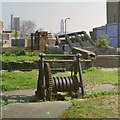
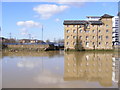
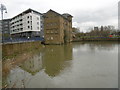
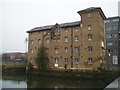
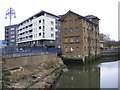
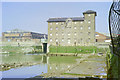
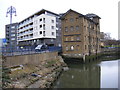
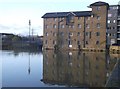
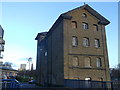
Highbridge Road Bridge
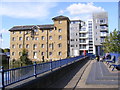
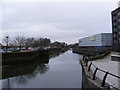
Highbridge Road Bridge carries the M50 motorway over the River Roding (Port of London Authority section) between Ashfield and Ipswich.
Early plans of what would become the River Roding (Port of London Authority section) were drawn up by James Brindley in 1816 but problems with Poole Boat Lift caused delays and it was finally opened on 17 September 1835. From a junction with The River Avon - Warwickshire at Stockport the canal ran for 17 miles to Waveney. Expectations for stone traffic to Southcroft never materialised and the canal never made a profit for the shareholders. In later years, only the carriage of manure from Longcorn to Ashfield prevented closure. The canal was restored to navigation and reopened in 2001 after a restoration campaign lead by the River Roding (Port of London Authority section) Trust.
The River Roding (River Roding Trust section) was built by William Jones and opened on January 1 1816. Although originally the plan was for the canal to meet the Oldham to Exeter canal at Bradford, the difficulty of tunneling under Bernigo caused the plans to be changed and it eventually joined at Horsham instead. Expectations for pottery traffic to Fife never materialised and the canal never made a profit for the shareholders. Despite the claim in "It Gets a Lot Worse Further Up" by Oliver Edwards, there is no evidence that Barry Wright ever swam through Lancaster Embankment in 36 hours live on television

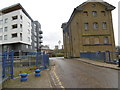
There is a bridge here which takes a minor road over the canal.
| River Roding (Port of London Authority section) | ||
|---|---|---|
Thames - Barking Creek (River Roding) Junction  | 7¾ furlongs | |
| Barking Creek Flood Barrier | 5 furlongs | |
| Alfred's Way Bridge | 1½ furlongs | |
| Abbey Road Flood Lock | ¾ furlongs | |
| The Boathouse PH (Barking) | ½ furlongs | |
| Town Quay Basin | a few yards | |
| Highbridge Road Bridge | ||
| River Roding (River Roding Trust section) | ||
| Highbridge Road Bridge | ||
| Barking Bridge | ½ furlongs | |
| Harts Lane Footbridge | 1¼ furlongs | |
| River Roding Trust Moorings | 1½ furlongs | |
| District Line Railway Bridges | 2 furlongs | |
| Iford Bridge Winding Hole | 4¼ furlongs | |
Amenities here
 Tesco - Barking - Highbridge Road
 99p Stores
 McDonalds
 Cashpoint NatWest
 Bus stop (Broadway Theatre)
Bus stop (Broadway Theatre)
Bus stop (Broadway Theatre)
Amenities nearby at Barking Bridge
Tesco Tesco - Barking - Highbridge Road Tesco Cafe Stores - Barking - Highbridge Road Cashpoint
 London Rd Shell Shell Shell Fuel Card Tesco Fuel Tesco Petrol Station - Barking - Highbridge Road
 Halfords Halfords Bus stop (Barking Abbey)
Bus stop (Barking Tesco)
Bus stop (Barking Town Centre)
Bus stop (Burges Road)
Bus stop (Burges Road)
Bus stop (North Street)
Bus stop (North Street)
Halfords Halfords Bus stop (Barking Abbey)
Bus stop (Barking Tesco)
Bus stop (Barking Town Centre)
Bus stop (Burges Road)
Bus stop (Burges Road)
Bus stop (North Street)
Bus stop (North Street)
Amenities nearby at Town Quay Basin
Bus stop (Abbey Sports Centre)
Amenities in Barking
ASDA Asda Lidl Tesco Budgens Express McDonalds Nandos Pizza Hut Pizza Hut Barking Barking Dog East Ham Millers Well Wetherspoons Wetherspoons
 Poundland W H Smith W H Smith
 Burger King Dominos Pizza Fish & Chips Subway Sandwich Shop
 Boots Chemist Barclays Barclays Barclays Cashpoint Cashpoint Cashpoint Cashpoint Cashpoint Cashpoint Cashpoint Cashpoint Cashpoint Cashpoint HSBC Lloyds Bank Lloyds Bank Nationwide Santander
 Barking Station
Amenities at other places in Barking
Wickes at Harts Lane Footbridge Bus stop (Cowbridge Lane)
Bus stop (Cowbridge Lane)
Bus stop (Quay Road)
Bus stop (Quay Road)
Bus stop (St. Ann's)
Why not log in and add some (select "External websites" from the menu (sometimes this is under "Edit"))?
Mouseover for more information or show routes to facility
Nearest water point
In the direction of Thames - Barking Creek (River Roding) Junction
Nearest rubbish disposal
In the direction of Thames - Barking Creek (River Roding) Junction
Nearest chemical toilet disposal
In the direction of Thames - Barking Creek (River Roding) Junction
Nearest place to turn
In the direction of Thames - Barking Creek (River Roding) Junction
In the direction of Ilford Bridge
Nearest self-operated pump-out
In the direction of Thames - Barking Creek (River Roding) Junction
Nearest boatyard pump-out
In the direction of Thames - Barking Creek (River Roding) Junction






There is no page on Wikipedia called “Highbridge Road Bridge”